

AANS Neurosurgeon : Features
Volume 24, Number 1, 2015
Measuring Luxury Hotel Guest and Employee Experiences — the Relevance to the Hospital Patient Experience
Jim Treadway, Jamie Treadway, Tamara Kliot and Michel Kliot, MD, FAANS
Historically, lodging industry management has been populated more with people who worked their way up from hourly positions than MBAs and others with significant sophisticated business experience. While other businesses, particularly manufacturing, were studying and learning from what was going on in Japan in the 1980s, the lodging industry continued to manage by opinion, experience, and consensus, as opposed to making data-based decisions. (1)
Measuring the Quality of Guest Experience
By 1990, Japan and its industrial giants like Toyota were teaching the rest of us statistical process control and the broader initiative of what was then-called total quality management (TQM). Deming, in his writings, brought TQM to the U.S., embracing the Japanese concept of “Kaizen” — the need for continuous improvement — the day a business stops improving is the day it starts going out of business. (2)
Two lodging industry branded management companies were paying attention — Ritz Carlton and Westin.Both set about studying and executing TQM in the early 1990s. Ritz Carlton had its eye on the prize of a Malcom Baldrich award for quality (3), whereas Westin was more focused on streamlining processes, realizing efficiencies, engaging the brains of all employees, not just managers, and eliminating organizational hierarchy (4). Both Ritz Carlton and Westin, independent of each other, were keen on improving the guest experience, as well as the employee experience, while at the same time reducing operating costs. Easier said than done.
Westin studied every process that occurs in a hotel; there are thousands. Consider the process of taking “things” to and from a guestroom — everything from food and drink to luggage to ironing boards, to shined shoes, etc (4). Back then, the bell department delivered and retrieved luggage; the room service department dealt with food and drink; housekeeping department dealt with irons and ironing boards; and the laundry and valet department dealt with guest laundry and dry-cleaning. Each department had its own management structure, uniforms and departmental accounting. Westin determined that the process of taking things to and from a room could and should be just one department — hence, the birth of the concept of the Service Express department. The benefit to the guest was enormous — employees, all directed by radio from a central command center, moving throughout the hotel picking up items and delivering them, allowed for quicker response times. One-way trips were eliminated. An employee delivering something would pick something else up on the return trip. Everybody wins — the guest by improved response times, and the hotel by lower operating costs.
The time and motion studies that went into this simple process improvement were significant, and validated a basic premise of TQM — that if you can’t measure it, you can’t improve it. And as an industry, the hotel guest experience was not measured in a statistically valid way. Guest comment cards were the primary source of customer satisfaction, and they were anecdotal, at best, not always read and rarely responded to.
The Evolution of the Hotel Guest Experience
Fast forward to the present. At a good hotel, guests check out of a hotel and automatically receive detailed electronic surveys of all elements of their stays, both before they arrived (the reservation process) and during. If the cover letter to this survey is compelling and highly personalized and the guest’s stay so memorable (hopefully positively so), the return rate of surveys will be high ( >10%). If the stay was superb, the likelihood for a returned survey goes up even further. The same for a horrible stay. The guest wants to reward/thank the hotel or punish it.
The survey offers a lot of data that can be sliced and diced, resulting in improvement opportunities identified and corrections undertook. But of equal importance is the hotel’s personalized response to each survey that can inspire the guest to become a customer for life, as well as a salesperson for the hotel. The satisfied customer is supplied with a prompt to go online and write a favorable review. Hotels live or die by what is said about them on TripAdvisor, Yelp, Expedia and other online review entities. This is basic one-to-one marketing, as well as the conversion of word-of-mouth marketing, reaching a handful of people, to word-of-web marketing, reaching thousands.
Websites today have little credibility, as they often are embellished to the extent that the reality of the actual hotel bears little resemblance to its website’s photography. Very few people book a hotel for a getaway or vacation without spending considerable time researching it online; their first stop in their research is invariably TripAdvisor.
Also, in recent years, the connection between the employee’s human spirit and productivity has been established (5). This is the basic belief that happy employees do their jobs better and provide superior service than unhappy ones. Toward that end, the hotel industry has gone to great lengths to focus on and quantitatively evaluate the employee experience, just as much as the guest experience, with annual or semi-annual employee satisfaction surveys that are statistically valid and anonymous. So for as many guest satisfaction initiatives there are within fine hotels, there are even more employee satisfaction initiatives. The great hotels of the world want their guests to feel very special and cared for, and they know their employees have to feel the same way.
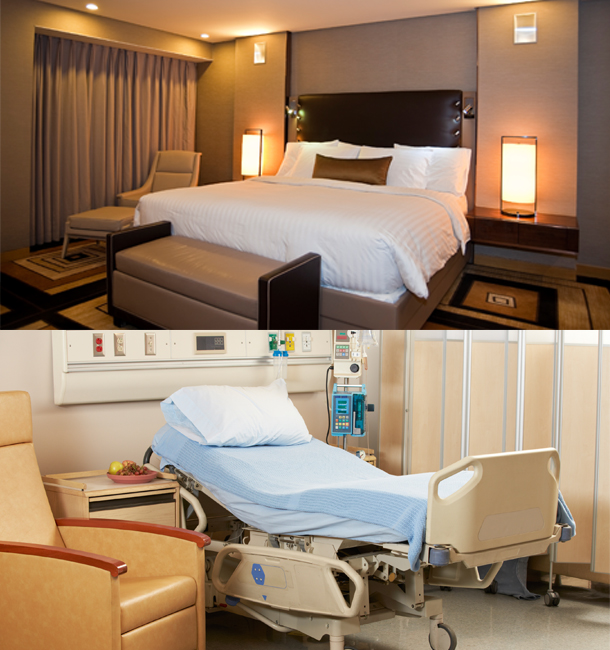
Hospitals and hotels have as much in common as they do not. They both have a pre-arrival/admissions process, a residential component, dining, a departure/discharge process and follow-up. They both create memories, hopefully positive. The obvious difference: Hotels don’t repair and heal people, they just ideally re-energize and rejuvenate their guests. Up until recently, hospitals focused their improvement efforts almost exclusively on the delivery of excellent health care. This bias is reflected in the fact that hospital rankings for the most part reflect the reputation and performance of its medical and surgical departments.

Enter Metrics for Hospital Care
Metrics were first introduced into hospital care in order to improve the safety of administered medical care by reducing the substantial number of errors that occur, as well as reduce the number of avoidable complications (6). Checklists became mandatory during surgical procedures to prevent such catastrophic events as wrong-side surgery, and care pathways were developed to implement best practices to reduce such complications as urinary tract infections and deep vein thrombosis. It was not until Medicare/Medicaid reimbursement became contingent on metrics (HCAPS) (7), reflecting other aspects of the hospital experience that hospital administrators began to concern themselves with how patients experienced their hospital admission (8). Hospital administrators now not only had to concern themselves with the costs and effectiveness of delivering state-of-the-art health care, but also the manner in which it was being delivered and experienced by the patient. As a result, an industry of hospital consultants came into being in order to identify and help implement best practices aimed at increasing patient satisfaction and HCAPS scores.
Hospital consultants, such as the Studer Group, began to meet these needs and develop acronyms to influence and help improve human behavior. For example, AIDET for Acknowledge, Introduce, Duration, Explain, and Thank you to encapsulate important elements that health-care providers should manifest in greeting and caring for patients (9) (10). Although useful, these aids and mnemonics have only begun to scratch the surface of enhancing the patient experience in a manner analogous to that provided by the luxury end of the hotel industry. What follows is a blueprint on how the hospital industry could benefit from practices widely and effectively employed by the hotel industry.
Imagining a Different Hospital Experience
The patient prior to ever arriving at the hospital must submit a large amount of personal information, a lot of which deals with past and present medical problems, but also includes a lot of personal information. And yet upon arrival, the patient is usually greeted and treated as a complete stranger, and must often repeat the process, sometimes more than once. There is no good reason that this trove of personal information could not be preloaded into the patient’s digital medical record and be available to the admissions staff, so that the patient is greeted as someone we have been expecting and whose needs have been anticipated. Instead of “What’s your name, and why are you here?” the patient could be greeted with “Good afternoon, Mr. or Mrs. X.We have been expecting your arrival to treat your spine problem.Your room is being prepared and should be ready shortly. Until then, let us provide you with information about and photographs of your health-care team. Please let us know if you have any questions. If you are hungry, you can select several restaurant options on our main floor. Here is a pager that will beep when your room is ready. We look forward to providing you with the best care possible.”
Who and What to Expect During Hospital Stays
Once the room is available, someone could and should escort the patient to their floor and room where they can be introduced to the staff and their medical team. They should be educated on the use of white boards that, despite being present in most patient rooms, usually remain white and blank.Instead, the names of the attendings, nurses, residents, medical students and nurse practitioners or physician assistants could be listed on the white board or in a provided brochure, as well as a schedule of when to expect rounding staff (11). Much of this information could also be provided in a preadmission letter to the patient, so as to both inform him or her and set realistic expectations. Patients are often unaware of who has seen them and what their training and expertise are. Knowing that their attending will see them daily or that they will be seen on weekends by a cross-covering attending is both reassuring as well as respectful. Patients are often ambushed by tests and procedures, instead of informed ahead of time of what to expect so that they can plan their day and coordinate time with their family and other visitors. Again, the white board is a useful vehicle to update and inform the patient of what lies ahead for him or her. Patients usually enter the hospital with a high level of anxiety and sometimes even fear. Minimizing the unknown and creating a welcoming and friendly environment can only help the patient to prepare for and deal with the physical, psychological and emotional challenges of their illness or procedure.
Problems Resolved Result in Satisfied Customers
In the hotel industry, when a problem occurs during a customer’s stay, every effort is made to identify and remedy it as soon as possible, a process known as recovery. In the hospital world, a problem is often viewed as unavoidable, and the consequences are upset patients, who then voice their dissatisfaction usually on a questionnaire they receive several weeks following their discharge. A much-better strategy would be to address the problem as soon as it is recognized, have someone in a position of authority express regret in an empathic and understanding manner, while taking responsibility for what happened, and make every attempt to fix the problem as soon as possible. Staff in the hotel industry will often try to make amends by providing some additional service or benefit. There is no reason that the hospital staff could not do the same for patients, whether it be a free meal, chocolates or flowers. What people in the hospitality industry have found over and over again is that a mistake that is redressed well can engender a sense of gratitude and satisfaction in the customer that will not only make him or her a loyal customer, but also produce an evaluation, either verbal or written or on the Internet, that is even more positive than had the problem never arisen. Instead of viewing a problem as something to be minimized or denied, it is better to view it as a challenge to be overcome as soon as possible. And if it is dealt with well, the process of dealing with a problem could actually be beneficial to the hospital’s reputation.
Leaving a hotel is usually a straightforward process; the bill is provided and paid, and the bell captain is notified to fetch the luggage and provide appropriate transportation. In a hospital, discharge of the patient is perhaps the single most critical and difficult transition for the patient, comparable to the landing portion of an airplane trip. Hospitals try to provide a realistic discharge time, prescription for medications, and instructions for care and follow-up. Unfortunately, much more is needed. Patients, and even their caregivers, often forget what the instructions are. Complications often occur, which may lead to an unexpected readmission. One practice that has been shown to be effective is to actually provide an audio or even video recording of the discharge instructions that the patient and their helpers can replay later. Another strategy is to identify patients at high risk for readmission and provide them with much more frequent follow-up, either in person or at least with a phone call.
Happy Hospital Employees = Happy Patients
Another important lesson that the hotel industry offers the hospital industry is the recognition that happy employees lead to happier customers, which would translate to happier hospital employees produce happier and better treated patients (10). It also makes financial sense since happier employees are not only more likely to work harder and more efficiently, but also there is less employee turnover. However, keeping hospital employees happy as we ask more of them will be a challenge. It is often leadership at the highest level, by setting an example of what it is like to work hard, while keeping a positive and upbeat attitude, respecting and acknowledging the accomplishments of ones co-workers and subordinates, and being willing to chip in by actually rolling up ones sleeves and doing whatever is necessary to get the job done, that has the most widespread and long-lasting impact. Few sights are more inspiring than seeing the CEO in the trenches hauling freight with the soldier workers.
As hospitals are trying to improve the patient experience, hotels are trying to enhance the health and wellbeing of their customers. Healthier meals are being offered, fitness centers are available, and even the construction and design of hotels is being done in an environmentally friendlier manner (e.g. U.S. Green Building Council’s LEED certifications from just “certified” all the way up to LEED “platinum”-certified) (12). Each industry can benefit from what the other does best. Hospitals can learn ways to better interact with patients and anticipate their needs. Hotels can create an environment that is not only enjoyable, but also promotes good health. As we become more adept at measuring results, we can begin to replace ineffective dogmatic practices based on tradition with more proven and successful practices. Change is inevitable. The challenge is to constantly measure our performance and use the results to improve the experience not only of our patients and customers, but also of our health-care providers and staff. To quote Mother Teresa, “The miracle is not that we do this work, but that we are happy to do it.”
Jim Treadway is a Cornell Hotel School graduate, and spent 23 years with Westin Hotel & Resorts — his last five as president of the North America Division. In 1996, he founded MTM Luxury Lodging, an hotel management company specializing in small luxury hotels. He and his partners sold his company to Benchmark Hospitality in 2011, at which time Treadway was also the general manager of Bardessono in Yountville, Napa Valley, Calif. — the position he holds today. Jamie Treadway is finishing her third year at Rush Medical School in Chicago and is seriously considering a career in neurosurgery. Tamara Kliot completed two years working for Teaching for America as a high school teacher in New Orleans, teaching chemistry and physics. She is interested in pursuing a career in medicine. Michel Kliot, MD, FAANS, is professor and director of Peripheral Nerve Center and patient/staff satisfaction advocate, department of neurosurgery, Northwestern University Feinberg School of Medicine, Chicago. The authors reported no conflicts for disclosure.
References
5. Schwartz, Tony. Be Excellent at Anything. Free Press, 2010.