

AANS Neurosurgeon : Education
Volume 22, Number 3, 2013
The Neurosurgery Matrix and Milestones: The Future of Education and a Benchmark for Patient Safety
Stacey Quintero Wolfe, MD, FAANS
 Photo courtesy of Deborah L. Benzil, MD, FAANS.
Neurosurgery is at the forefront of replacing the era of training as a service apprenticeship with a deliberate, patient-centered education focused on patient safety, clinical outcomes and the advancement of neurological surgery.
In an effort to reduce the burden of the current residency accreditation process and provide accountability for training outcomes, the Accreditation Council for Graduate Medical Education (ACGME) is launching the Next Accreditation System (NAS). The first seven specialties, including neurosurgery, were scheduled to begin in July 2013. This new system will replace the periodic program reviews with a continuous accreditation model based on annual review of submitted data: changes in faculty or residents, scholarly activity, American Board of Neurological Surgery (ABNS) pass rate, resident and faculty surveys, case logs to document clinical experience, semi-annual resident evaluations and Milestones.
As a critical element of the NAS, the Milestones concept creates more specific, objective and quantifiable goals during medical training than the Core Competencies alone. They take into account differences in the progression between trainees, as well as differences between certain knowledge and technical skill acquisition. These Milestones are meant to track the most important aspects of the learning process, which can be documented by faculty on a continuum of increasing ability over time. The Residency Review Committee (RRC) will be able to use compilation of Milestone results to determine if a given training program is performing above, at or below national norms.
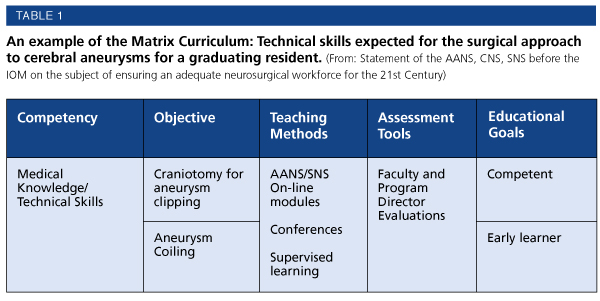
Neurosurgery, through the groundbreaking work of the Society of Neurological Surgeons (Senior Society), has taken the additional step of correlating the Milestones concept to a comprehensive neurosurgical curriculum, the Matrix Curriculum. Named for its multidimensionality, it correlates competencies, objectives, teaching methods, assessment tools and educational goals, and is training level-specific, with different expectations for junior, senior and chief residents (Table 1). The new Matrix Curriculum defines the roadmap for neurosurgical residency training, while adhering to the ACGME format and using established goals of the ABNS and RRC.
As a cornerstone of the Matrix Curriculum, all first-year neurosurgical residents attend the SNS’ Neurosurgery “Boot Camp,” which uses standardized model-based teaching and simulators for technical and cognitive/behavioral skill learning.
It focuses on fundamental skills, patient safety, professionalism and communication. Fundamental bedside procedural, operative skills and neurosurgical basics are taught in an educational and risk-free environment. The course is held in six regional centers and staffed by SNS-appointed faculty.
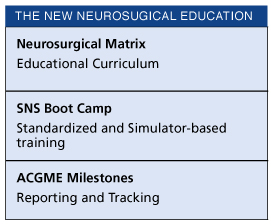
The Matrix Curriculum unifies all of the education, accreditation and certification functions by aligning neurosurgery’s educational goals, the ACGME competency and Milestone project requirements, and the medical knowledge and technical skill components required for board certification in neurological surgery. Each ACGME Milestone will be linked to the elements of the Matrix Curriculum in the new Web Portal, which will facilitate Milestone assessment and tracking.
Neurosurgical clinical training is rigorous, as would be expected for a specialty that requires both cognitive and technical expertise. Neurosurgery again has led the way by creating a specialized curriculum and benchmarks by which to quantify training, in order to exceed national standards, practice with excellence and inspire public trust.
 Stacey Quintero Wolfe, MD, FAANS, is an assistant professor at Wake Forest University, and a member of the AANS Neurosurgeon Editorial Board. The author reported no conflicts for disclosure.